

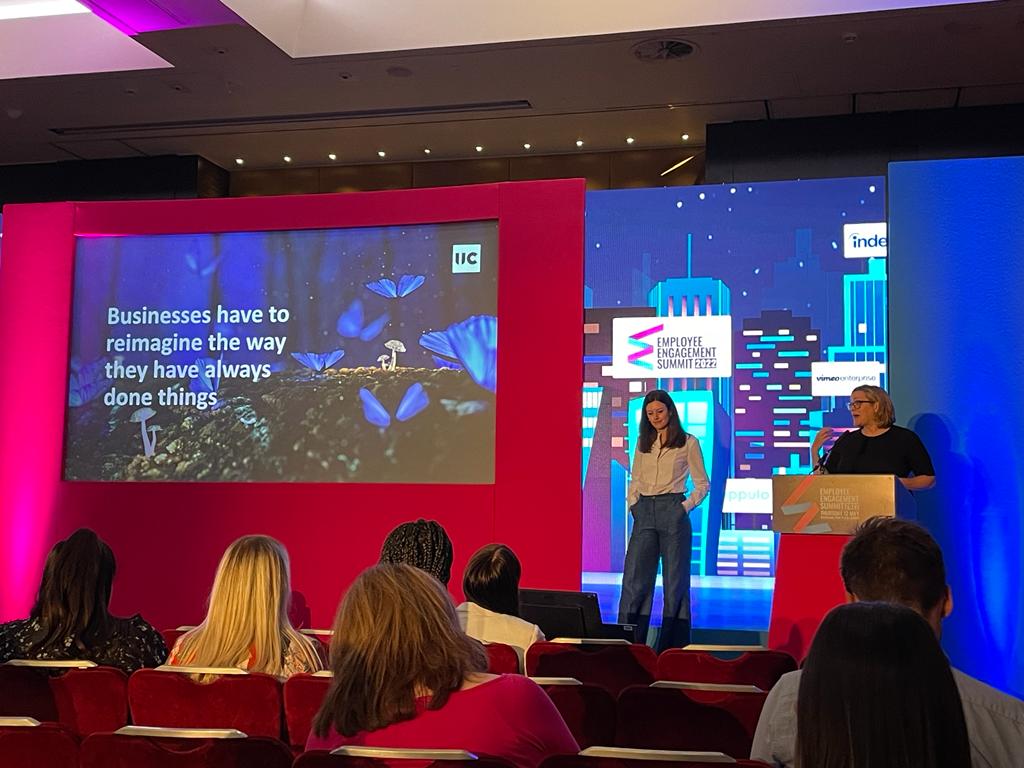

Last week saw the welcome in-person return of London’s annual Employee Engagement Summit, attracting more than 700 delegates. United Culture sponsored the event and Victoria Lewis-Stephens and Alys O’Neill spoke about supercharging culture in a hybrid world. They joined an interesting line-up of speakers to consider how best to crack the communications conundrum of the day: how to drive culture, engagement and wellbeing in a hybrid workplace?
Keynote Speaker and Hockey Gold Medalist & Former Captain Kate Richardson-Walsh stressed the importance of taking time to re-evaluate Purpose and Values. As part of the team that took bronze at the London 2012 Olympics, and which two years later slumped in the world, Kate talked about drawing a line under what is no longer serving you. “We realised our values of ‘striving for gold medal standards everyday’ just wasn’t working anymore,” she said. “The rise of toxic behaviours and silos in our team following a period of uncertainty and change meant we had to have some very honest, messy conversations.”
Adopting the mantra, ‘Be the Difference, CreateHistory and Inspire the Future’, the team came up with new values together, rooted in where they were now: ‘We are winners, We are one team, We are alive’. “The behaviours that sat underneath were all about accepting ourselves and each other as part of one team,” Kate said. “It’s ok to talk, I will listen. I’ve got your back, and you’ve got mine. We stand together and we are connected. Let’s share the load.”
They also embarked on a process to identify their super strengths, weaknesses and biases, developing a deep understanding of themselves and each other. “We started off thinking the challenge was how to bring together a disparate group containing individuals that usually compete against each other,” said Kate. “But we realised our opportunity was how to leverage our differences and diversity to our competitive advantage.” It’s no surprise, after all this soul-searching, that the team went on to win Gold in the nail-biting final of the Rio Olympics.
Kate ended with the British-American psychologist, consultant and former professional basketball player John Amaechi OBE, who said, ‘culture is defined by the worst behaviour tolerated in ourselves and others’. Accountability – from the top down – was key to instilling trust back into the team. “In a hybrid environment, it’s important to make the time we spend together more meaningful,” she concluded.
The role of leadership in driving meaning at work was also the secret to strengthening human connection in a hybrid world, according to Stuart Curtis, Senior Director – Global Talent Development at Workhuman. To thrive and do their best work, employees need to feel seen, appreciated and valued for who they are and what they do – which is why Workhuman makes gratitude and recognition part of the lifeblood of the business.
Getting this right in today’s highly dispersed and fragmented environment was difficult, but not impossible , according to Curtis. “Don’t underestimate the impact of saying thank you – employees are half as likely to look for a new job, twice as likely to be highly engaged and three times as likely to see a path for growth within the organisation if they are thanked for the work they do,” said Curtis.
He also advised making gratitude public, as the impact of witnessing employees being thanked drives psychological safety, reduces the feeling of burnout and stress and increases a feeling of connection across your workforce.
Nicole Bearne, Internal Communications Manager, Mercedes-AMG Petronas Formula OneTeam, highlighted the importance of leadership and the personal touch during times of crisis. Being within the fast-paced world of Formula One motor racing, Bearne’s experience of outstanding leadership is second to none.
Working alongside some of the racing greats from Michael Schumacher to Lewis Hamilton, she has seen close-up the role that leaders have in building high performance teams. “As a leader, it’s so important to hold your team front and centre in your attention,” she said. “Remembering people’s birthdays, knowing the names of their kids and what they got up to at the weekend – these small details show you care about every individual in the team, no matter what role they play.” Authentic leadership, from her perspective of being part of an 8-time world championship winning team, was also about openly failing to succeed.
“Leaders being open about their own painful experiences of failure also paves the way for their teams being more open to learning,” she said. “We always abided by the mantra that the days we fail are the days our competitors will live to regret.”
Learning how to re-imagine the employee lifecycle and the moments that really matter was United Culture’s own Victoria Lewis-Stephens and Alys O’Neill’s take on how to build a culture fit for a hybrid world. It’s a process that needs reflection. They recommended that businesses ask themselves two key questions which would impact their starting point.
Is your company culture defined and fit for the future but not showing up consistently? Or do you need to see different behaviours to come to the fore across the business for you to live your purpose and deliver your strategy?
“If the first question resonates, the chances are you need to take a step back and look at your end-to-end employee journey and ensure at every opportunity you are creating an experience that allow the right behaviours to thrive. That will involve you doing more than just putting things online or flipping things to being virtual. You need to rethink and get creative about how you create a truly branded hybrid experiences,” said Lewis-Stephens. “But if you need to see different behaviours, come to the fore, you will need to go much deeper.”
A starting point would be getting under the skin of your purpose and strategy so you can really understand what behaviours you need to see across the business, she explained. “Assess where you are today, where you need to get to, then work out what you need to do to close the gap,” Alys added. “And get your leadership team onboard – as there is very little chance of changing a culture without them.”
Victoria highlighted United Culture’s proprietary assessment tool, Culture Unleashed, as one way for organisations to identify which behaviours and traits associated with a high-performing their leaders currently exhibit. It can help to spark conversations around the behaviours that underpin culture, and enables leadership teams to consider culture through a different lens.
Find out more here.


